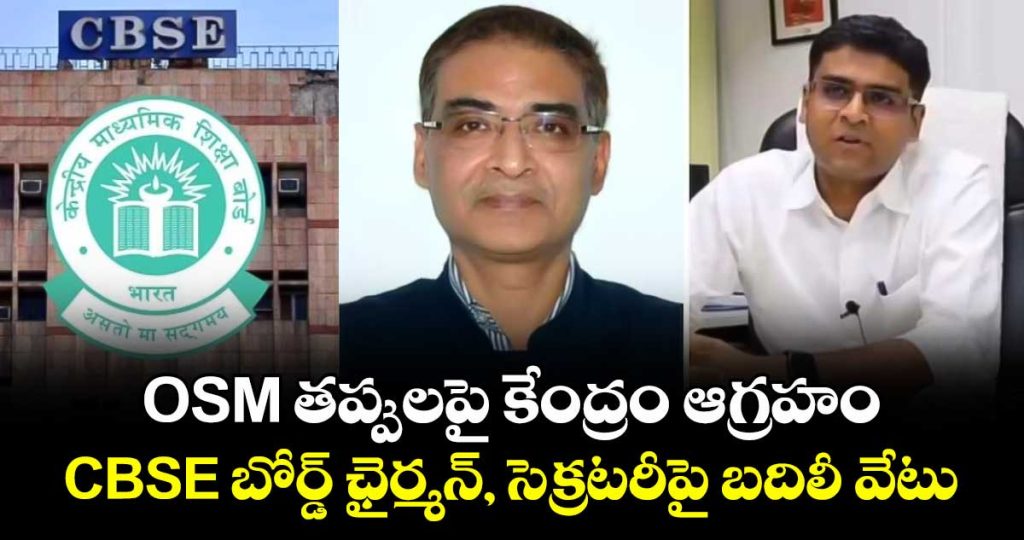
Central Government Moves to Address OSM Discrepancies
Indiabreakingdaily.com – The Central Government has taken decisive action to address the mounting issues surrounding the On-Screen Marking (OSM) system, which has been at the center of controversy due to reported errors in the evaluation process. Officials have announced the transfer of key personnel, including CBSE Board Chairman Rahul Singh and Secretary Himanshu Gupta, as part of their efforts to rectify the problems and restore confidence in the system. This move comes after a series of complaints from students, parents, and educators about inconsistencies in the OSM results, which raised questions about the accuracy and transparency of the process. The decision to transfer these officials was made in response to the growing public scrutiny and the need for accountability in the administration of CBSE examinations.
The OSM System and Its Role in CBSE Exams
OSM, or On-Screen Marking, is a digital system introduced by the Central Board of Secondary Education (CBSE) to streamline the evaluation of answer sheets for students appearing in board exams. The system allows examiners to mark papers electronically, reducing the risk of human errors and speeding up the process. However, recent reports have highlighted significant discrepancies in the OSM results, particularly for Class 12 examinations, where the scores for some students deviated substantially from their handwritten evaluations. These errors, whether due to technical glitches or procedural lapses, have sparked widespread concern among stakeholders, leading to calls for an independent review of the OSM methodology.
One of the primary criticisms of the OSM system has been its inconsistency in scoring, with some students facing lower marks than expected despite identical answers. This has raised fears of bias and inaccuracies in the automated grading process. Additionally, the lack of clear communication from CBSE about the system’s mechanisms and the steps taken to correct errors has further fueled public distrust. The Central Government’s decision to transfer the chairman and secretary of the board signals a commitment to resolving these issues, but it also underscores the urgency of addressing the root causes of the OSM-related problems.
The Inquiry Committee and Its Findings
In response to the OSM discrepancies, the government established an inquiry committee to investigate the system’s functionality and the responsibilities of those involved in its implementation. The committee’s mandate includes examining the technical aspects of OSM, the training provided to evaluators, and the verification processes in place to ensure accuracy. Preliminary findings suggest that while the OSM system is designed to enhance efficiency, its reliance on a centralized database for result processing has led to occasional data entry errors and mismatched scores.
The inquiry has also focused on the timeline of events leading up to the controversy. Reports indicate that the OSM errors were detected as early as the first week of May, prompting CBSE to issue temporary fixes. However, these adjustments were not sufficient to eliminate the concerns, especially as the final results were announced on May 13, coinciding with the announcement of the personnel transfers. The committee is expected to release its detailed report in the coming weeks, which will likely outline recommendations for improving the OSM system and preventing similar issues in the future.
Meanwhile, the Central Government has emphasized the importance of transparency and fairness in the evaluation process, stating that the transfers are part of a broader effort to ensure accountability. Officials have assured that the OSM system will undergo thorough modifications to address the identified flaws, including enhanced training for evaluators and stricter quality checks. These measures aim to align the system with the expectations of students and parents, who have demanded greater accuracy and reliability in the scoring of their exams.
Impact on Students and the Education System
The OSM controversies have had a tangible impact on students, particularly those in the Class 12 category, whose results are crucial for college admissions and career planning. Many students reported feeling anxious and uncertain about their grades, with some even challenging their scores through the CBSE’s grievance redressal mechanism. This has created a sense of instability in the education system, as the accuracy of exam results directly affects academic progression and opportunities.
Parents and educators have also expressed frustration, arguing that the OSM errors could compromise the credibility of the CBSE’s evaluation process. Some have called for a complete overhaul of the system, while others advocate for a hybrid model that combines automated marking with manual verification. The Central Government’s decision to transfer the chairman and secretary of the board has been seen as a positive step toward addressing these concerns, though the long-term effectiveness of the changes will depend on the implementation of the committee’s recommendations.
As the education system grapples with the aftermath of the OSM issues, there is a renewed focus on the need for technological reliability in high-stakes examinations. The Central Government’s proactive approach, including the establishment of an inquiry committee and the restructuring of key roles, demonstrates a commitment to resolving the problems and preventing future discrepancies. However, the success of these measures will hinge on their ability to address the underlying technical and procedural challenges that have plagued the OSM system.