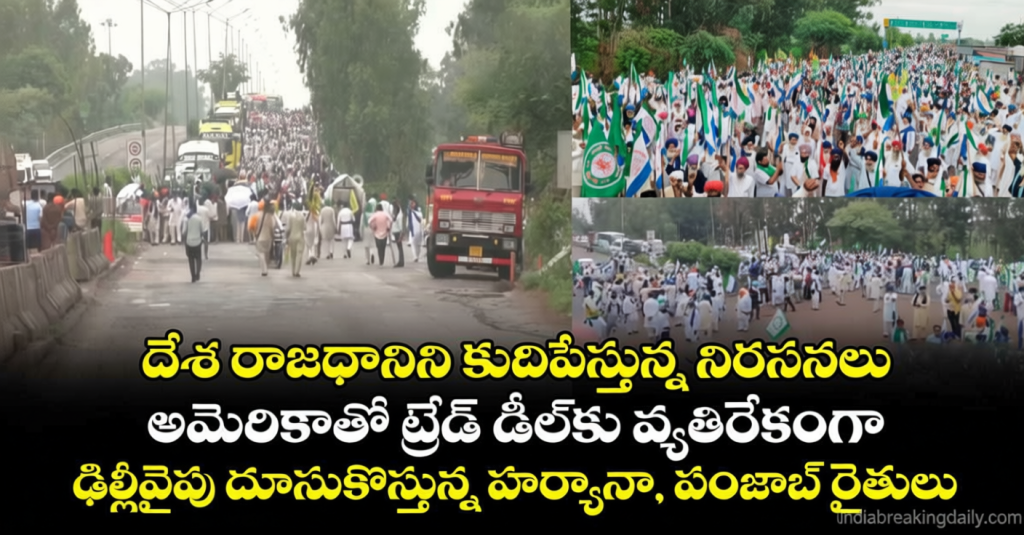
Indiabreakingdaily.com – ద శ ర జధ న న క – “`html
Thousands of Farmers March Toward Delhi Amid US Trade Deal Concerns
While student demonstrations continue across the capital over examination irregularities, agricultural communities from neighboring states have begun their journey toward New Delhi. The dual movements reflect growing public discontent with government policies on multiple fronts. Thousands of cultivators are now making their way to the nation’s capital, carrying their concerns about international trade agreements that could fundamentally reshape India’s agricultural landscape.
Border Tensions Emerge as Farmers Gather
Thousands of cultivators from Haryana and Punjab are converging on the national capital ahead of a planned Kisan Mahapanchayat at Kisan Ghat. Police forces have been deployed in significant numbers at the Shambhu border crossing to manage the expected influx. Barriers and concrete blocks have been positioned along roads, while the bridge over the Ghaggar river has been completely closed to traffic. Security personnel are working around the clock to ensure smooth movement of protesters while maintaining public order.
On Tuesday morning, July 21, farmers departed carrying both the national flag and banners representing agricultural unions. Many organized their travel through buses, with hundreds setting out from various locations across Punjab toward the capital city. The journey has been marked by solidarity and determination as farmers from different regions unite under a common cause.
A large number of farmers reach Shambhu Border (Punjab-Haryana border) ahead of their scheduled march to Delhi today. Visuals from Patiala (Punjab) side show the massive gathering of agricultural workers preparing for their historic demonstration.
Trade Agreement Sparks Widespread Opposition
The primary catalyst for this mobilization is the proposed commercial agreement between India and the United States. Agricultural leaders argue that the pending deal threatens to undermine domestic farming interests by allowing cheaper American agricultural products into the Indian market. They contend that such imports could significantly impact farmer incomes and the broader agricultural economy, potentially devastating small-scale producers who cannot compete with subsidized American crops.
According to union representatives, the proposed arrangement extends beyond limited commodities. It encompasses multiple sectors including dairy farming, industrial operations, digital commerce platforms, e-commerce businesses, government procurement mechanisms, intellectual property rights, and service industries. Farmers fear that small traders, micro-enterprises, and agricultural workers will bear the brunt of any negative consequences arising from this comprehensive trade framework.
Despite the agreement not yet being finalized, agricultural organizations are demanding its complete withdrawal. They have called upon the central government to intervene immediately and protect the interests of cultivators and ordinary citizens alike. The protests in Delhi represent one of the largest agricultural movements in recent years, with participants spanning multiple generations of farming communities.
Historical Context of Farmer Protests
This is not the first time agricultural communities have mobilized against government policies. In February 2024, similar demonstrations occurred when farmers traveled to Delhi seeking legal guarantees for minimum support prices for their crops. Central and state authorities had deployed substantial forces to prevent their advance, and those protests generated significant attention nationwide. The current movement builds upon that momentum, with farmers more organized and better prepared for sustained action.
Union leaders have accused the Haryana government of obstructing peaceful movement toward the capital. They maintain that their intentions remain non-confrontational and that the proposed trade deal requires reconsideration before implementation. The farmers’ demands include not only the withdrawal of the trade agreement but also comprehensive reforms in agricultural pricing mechanisms and import policies.
As the situation continues to evolve, authorities are monitoring developments closely. The outcome of this demonstration could have far-reaching implications for India’s agricultural sector and its international trade relationships. Farmers remain hopeful that their voices will be heard and that meaningful changes will emerge from this historic gathering in Delhi.
“`